
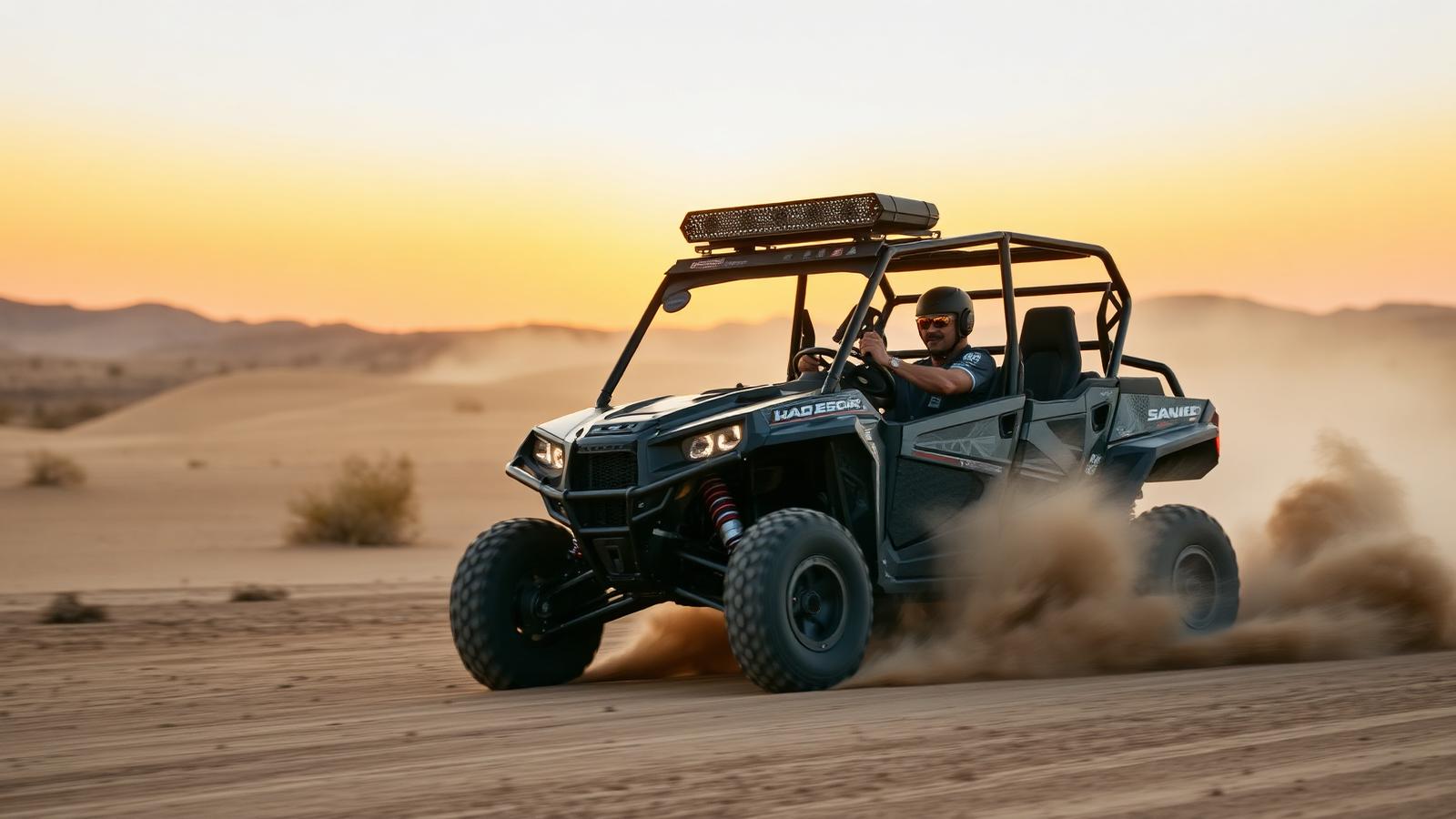
A side-by-side is the loudest passenger vehicle most people will ever ride in. A Polaris RZR Pro R puts out 110+ dB at the driver's ear at full throttle. Add wind noise, knobby tires on gravel, and the muffled effect of a helmet, and your music is competing against a small jet engine.
This is what makes UTV audio fundamentally different from car or marine audio. You're not building a system to sound nice. You're building a system that has to win a fight with the environment, and still sound good when it does.
Here's how we approach UTV and side-by-side audio at Audio Playground.
The math: how loud do you actually need?
To be heard clearly over a 100 dB background, music needs to be roughly 10–15 dB above that background — so 110–115 dB at the listening position. That's a lot. A typical car stereo at "loud" is around 95 dB. UTV systems need to be three to four times perceptually louder than a loud car stereo, just to be heard at all.
This drives every component choice:
- Speakers have to be far more efficient than typical car speakers (90+ dB / watt / meter)
- Amplifiers need real, honest power — 100–200 watts RMS per channel, not "peak" marketing wattage
- Subwoofers need to displace serious air to be felt over the suspension
- Wiring has to handle high sustained current without voltage sag
You can't fake any of this. A four-speaker $400 sound bar with no amp will disappoint you the first time you open the throttle. A real UTV system starts higher and pays off the moment you leave the parking lot.
The four common UTV audio configurations
Most builds fall into one of these four categories. Pick yours based on how the rig is used.
1. Front sound bar only
The simplest build. A single overhead sound bar (typically 25"–35" wide with 4–6 speakers) bolted to the roll cage or mounted to a pre-existing roof. The bar contains its own amplifier and Bluetooth source. You pair your phone, hit play.
Good for: trail riders who want music for the cruise, not for a party.
Brands: Bazooka, Wet Sounds Stealth XT, Kicker PowerSports, MTX Mud series.
Realistic cost: $700–$1,500 installed, depending on the bar.
This is enough sound for a quiet trail or a slow group cruise. It is not enough sound for high-speed dune runs or for music that needs to reach a rider standing 20 feet from the truck.
2. Front sound bar + sub
Add a powered subwoofer (typically 10" in a sealed enclosure rated for outdoor use) behind the seats or under the dash. This is the most popular build we do.
The sub does two things: it adds the low-end weight that makes music feel exciting, and — counterintuitively — it makes the sound bar sound louder by taking the bass workload off the small drivers in the bar so they can play cleaner.
Brands: Wet Sounds Stealth + Kicker PowerSports sub, MB Quart Reference, JL Audio Stealthbox.
Realistic cost: $1,800–$3,200 installed.
3. Front bar + rear bar + sub
The "party mode" build. A second sound bar mounted on the rear roll cage faces backward, so when you stop in camp, riders behind you can hear the music. Often paired with RGB lighting controlled from the head unit or phone app.
Cost: $3,000–$5,000 installed.
4. Full custom build with amplifier rack and multiple subs
The competition or showpiece build. Replaces the all-in-one sound bar with dedicated marine-grade pod speakers, a multi-channel amplifier in a sealed compartment, dual subs in a custom box behind the seats, and often dedicated DSP for cabin tuning.
Cost: $7,000–$15,000+ installed. The systems you see on YouTube doing 130+ dB at the dunes are this category.
What makes UTV speakers different
Two things separate good UTV speakers from car speakers:
- Environmental ruggedness. UTV speakers live outside, full-time. UV, water, dust, mud, sand, and vibration are constant. Spec the same way you would for marine: UV-stable cones, sealed motor structures, stainless hardware, drainage paths, and IP-rated enclosures (IP65 minimum, IP66 for top-rated tower pods).
- High sensitivity and high-frequency efficiency. UTV speakers need to throw clean high-frequency content past helmet shells and into ear canals. That means horn-loaded designs (Wet Sounds REV, JL Audio M6) or speakers with very high efficiency in the 2–10 kHz range where vocals and clarity live. A speaker rated 92 dB / watt will sound twice as loud as one rated 86 dB on the same power.
Brands we install constantly on UTVs: Wet Sounds, JL Audio M-Series, Kicker PowerSports, MB Quart, Rockford Fosgate Stage 5 RZR systems.
Source: the head unit problem
Side-by-sides don't have a dashboard in the traditional sense, so the head unit lives wherever you can mount it. Three options:
- Standalone marine Bluetooth controller: a small sealed unit (Fusion MS-RA70N, JL Audio MediaMaster) mounted on the dash. Cheap, reliable, controlled from a paired phone.
- Touchscreen marine head unit: a 7"–9" touchscreen Apple CarPlay / Android Auto display mounted in a custom panel. More features, more cost, more failure points in the dust.
- Phone as source, no head unit: many modern sound bars include their own Bluetooth receiver. The phone is the head unit. Simplest possible install.
For most riders, option 3 or option 1 is the right call. The full touchscreen makes sense for guided tour operations or rigs that double as group ride leaders.
Powering the system: don't kill your battery
A serious UTV audio system can draw 50+ amps under load. The factory battery and stator on most UTVs are sized for the engine, lights, and accessories — they were not designed to feed an audio system that draws as much current as the rest of the vehicle combined.
Three things to plan for:
- Upgraded battery: a deep-cycle or AGM battery rated for higher amp-hours than stock. Optima YellowTop is the standard go-to.
- Stator upgrade or DC-DC charger on big systems: if you're regularly playing music at idle or low engine speed, the factory charging system can't keep up. A high-output stator or a dedicated DC-DC charger from the engine system to the audio battery solves it.
- Cap (capacitor) for transient load: a 1–2 Farad capacitor in the audio system helps the amp respond to bass transients without dimming the headlights. This is more of a "polish" upgrade than a necessity.
The signs that you've under-powered the system: dimming dash lights on bass hits, the head unit resetting at full volume, voltage sag below 12V on the gauge, and the amp going into protect mode after a few minutes of hard play.
Dust, mud, and the install details that matter
The single most common UTV audio failure we see is water and dust intrusion into the amp. Riders mount the amp under the seat or behind a panel that's regularly exposed to mud and water from the wheels. Even a marine-rated amp will eventually fail in that environment.
Where to put the amp:
- Under the dash, behind the firewall: dryest spot in most UTVs
- In a sealed weatherproof enclosure mounted high on the roll cage
- Inside a dedicated audio box with its own cooling fan and drainage
Where not to put the amp:
- Under the seat (water collects there)
- In any compartment that opens to the wheel well
- Anywhere you'd hesitate to put a phone
The other big install consideration is vibration. UTVs ride harder than any car. Every component needs to be physically locked down — speakers with thread-locked bolts, amps on isolation mounts, wire runs zip-tied every 8 inches with strain relief at every connector. We've seen systems that sounded great in the shop and rattled apart in the first 50 miles because nothing was actually secured.
Tuning and the helmet question
Most UTV riders wear helmets. Helmets attenuate high frequencies more than low frequencies. That changes the EQ you want.
Without a helmet, a typical "flat" target curve sounds correct. With a helmet on, you'll want a few extra dB of presence in the 4–8 kHz range so the vocal clarity comes through. A simple DSP with a "helmet on / helmet off" preset is one of the most-loved features on the higher-end builds.
If you don't want to go full DSP, a head unit or sound bar with at least a 5-band EQ and a couple of saved presets gets you 80% of the way there.
What it'll cost, again
Honest 2026 installed prices from our shop:
- Entry sound bar build: $900–$1,500
- Sound bar + sub: $2,000–$3,200
- Front + rear bars + sub + LEDs: $3,500–$5,500
- Full custom amp rack + pod speakers + dual subs + DSP: $8,000–$15,000+
Most riders land in the second tier and stay happy for years. The full custom build is for serious enthusiasts who want their UTV to be the loudest one at the trailhead.
Common mistakes to skip
Five quick ones:
- All-in-one $400 Amazon sound bars. They don't survive the season. The savings disappear when you replace them.
- No sub. Music feels thin without low end. Even a 10" sealed sub transforms the experience.
- Stock battery. It will fail. Plan the battery upgrade into the audio budget.
- Bad mounting. Vibration kills more UTV audio gear than any other failure mode.
- No weather protection. Even one rainstorm can finish a non-rated amp. Treat it like a boat.
Where to start
If you're new to UTV audio and not sure what you want, the easiest way to figure it out is to come hear builds in person. We've got demo rigs at the shop and we can A/B different sound bars, subs, and amp configurations so you actually hear the difference instead of guessing from spec sheets. Then we'll spec something for the way you actually ride — quiet morning trails, mid-day dune sessions, or weekend camp parties. Each one calls for a slightly different system. The fun is in getting it right.