
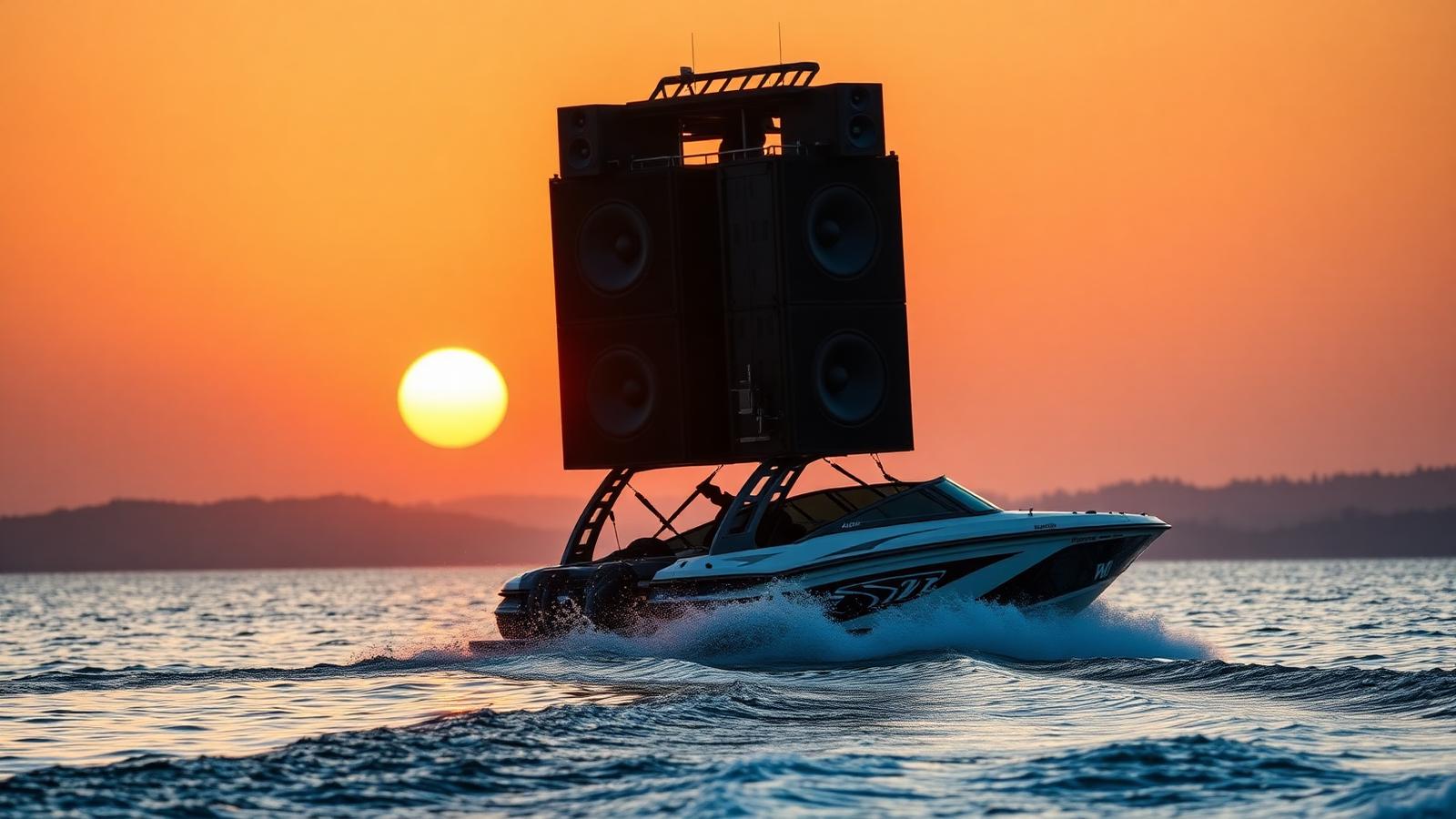
A boat is the worst possible environment for an audio system, and that's exactly why marine audio is such a satisfying thing to build right. UV rays attack every plastic surface. Salt mist (and fresh-water minerals on inland lakes) eat connectors. Pounding wave impacts loosen mounts. Engine noise, wind, and an open-air listening environment make even modest volume levels barely audible. And then somebody splashes lake water directly onto a tower speaker at 30 mph.
A marine system that survives all of that — and still sounds good — is engineered differently from a car system at every layer. This is the deep dive on how to build one that actually lasts.
Why you can't just use car audio on a boat
We get asked this constantly. "I've got a great Pioneer head unit from my old truck — can I just put it on the boat?" The answer is no, and here's why.
Car speakers use foam or rubber surrounds that crack under sustained UV exposure. The cone is paper or treated paper that swells and warps when humidity hits 90%. The voice coil is wound with copper that corrodes fast in salt or hard-water spray. The terminals are tin or unplated steel that turn green in a season. And the dust cap is a thin paper disc that water punches straight through.
Real marine speakers are built with:
- UV-stabilized polymer cones that won't yellow, crack, or warp
- Stainless steel hardware on every visible surface
- Rubber or Santoprene surrounds (not foam)
- Sealed motor structures so water can't reach the voice coil
- Coated terminals and gasketed mounting flanges
- Internal drainage paths so water that does get in flows out
Brands that we install constantly on boats: JL Audio, Wet Sounds, Kicker Marine, Rockford Fosgate M-Series, Hertz Marine, Audison APBX. Anything not labeled marine, even from a great car-audio brand, won't last a single season exposed.
How wet is "marine-rated"?
Marine ratings are a quiet mess. Different brands use different test standards. The IP code system (IP65, IP66, IP67) is the most consistent shorthand, and you should know what it actually means:
- IPx5: protected against low-pressure water jets from any direction. Most cockpit speakers.
- IPx6: protected against powerful water jets. Tower speakers, often.
- IPx7: can be immersed in 1 meter of water for 30 minutes. The top spec.
A speaker mounted under a hardtop in a center-console cabin only needs IPx5. A tower speaker that catches wake spray needs IPx6 minimum. A speaker on a pontoon that gets dunked at the dock occasionally should be IPx7.
The bigger trap is amplifiers. Most marine amps are splash resistant, not waterproof. Mount them in a dry compartment, somewhere ventilated, and they'll last forever. Mount them under an open seat where bilge water sloshes in, and they'll die in a year regardless of the marine label.
The four-zone marine system
A good boat audio system isn't one big system — it's three or four smaller systems that play together. We design them in zones:
- Cockpit / helm zone: 6.5" or 7.7" coaxials in the dash, kick panels, and cockpit liner. Where the driver and the front passengers actually listen at conversational volumes.
- Cabin / bow zone: 6.5" speakers in the lounge area for passengers up front, often on a separate volume control.
- Tower zone: tower speakers (typically 6.5" to 8" coaxial pods in protective horns) mounted on the wakeboard tower or T-top for the surfer or wakeboarder behind the boat.
- Sub zone: one or two enclosed marine subs under the helm or in the bow for low-end weight.
Each zone runs on its own amplifier channel and ideally its own volume control. That way the driver can keep the cockpit at conversation volume while the tower blasts at 105 dB for whoever is riding. Without zone control, you have one volume knob and everyone's miserable.
Tower speakers: where most of the budget goes
If you have a wakeboard or surf boat, the tower is the centerpiece. The rider is 60–80 feet behind the boat with engine noise, wind, and water spray between them and the music. Without serious tower speakers, they hear nothing.
A few rules:
- More speakers, not louder speakers. Two pairs of 6.5" tower pods almost always sound better than one pair of 8"s — more dispersion, more cone area, and a wider sweet spot for a rider who's drifting back and forth in the wake.
- Horn-loaded designs throw farther. Wet Sounds REV and JL Audio M6 horn-loaded tower speakers are 4–6 dB more efficient than non-horn designs, which doubles the perceived loudness at distance.
- LED-illuminated speakers are a real feature, not just a gimmick. Sunset surf sessions look incredible, and the lights run off the amp's remote turn-on lead.
- Aim them at the wake, not at the lake. Adjustable mounts let you tilt the speakers back and down toward the rider. Set-and-forget pods aimed straight back are aimed at empty water 90% of the time.
A tower system done right is two or three pairs of horn-loaded pods running on a dedicated 4-channel amp pushing 200+ watts RMS per channel. That's $3,500–$6,000 in gear before install. Worth every dollar if you actually use the tower.
Marine subs: yes, you can do it
A subwoofer changes a boat audio system the same way it changes a car system — it takes the low end off the smaller speakers, which lets them play cleaner and louder, and it adds the chest-thump that makes music feel exciting at low volume.
Marine subs come in two flavors:
- Enclosed marine subs that ship in a sealed UV-stable box — drop them under a helm, behind a seat, or in a storage compartment and wire them up
- Free-air marine subs designed to mount in a panel with the entire under-deck void serving as the enclosure — bigger sound, more install work
For most ski boats, wake boats, and cabin cruisers, a single 10" or 12" enclosed marine sub powered by a 500–800 watt monoblock marine amp is plenty. On pontoons or larger cabins, dual subs in the bow are common.
A note on power: marine subs eat amperage. Make sure your boat's battery and charging system can handle it. We often install a second battery dedicated to audio, isolated from the engine battery with a smart charger, so the music never strands you on the water.
Source: do you even need a head unit?
In 2026, most marine systems are designed around a media controller instead of a traditional head unit. The media controller is a sealed, sunlight-visible touchscreen that streams from a paired phone via Bluetooth or Wi-Fi. There's no CD slot. There's no AM/FM tuner unless you specifically add one. There's no glass to fog or crack.
Fusion (a Garmin brand) and JL Audio's MediaMaster line dominate the market. Both let you control multiple zones, run apps like Pandora and Spotify natively when paired with a phone, and integrate with Garmin chartplotters for unified helm controls.
If your boat doesn't have a chartplotter and you don't want a touchscreen, a simpler waterproof receiver with Bluetooth and a wired controller at the helm works fine too. Kenwood, JVC, and JL Audio all make models in the $250–$600 range.
Wiring: the part nobody photographs
The reason marine audio install rates are higher than car audio install rates is the wiring. Every connection needs to be heat-shrunk and adhesive-lined. Every wire needs to be tinned copper, not bare copper (bare copper corrodes from inside the insulation in a year). Every wire run needs to be loomed and clipped away from chafe points, away from heat sources, and high enough that bilge water never touches it.
Specifically:
- Tinned-copper marine-grade wire for every power and speaker run
- Adhesive heat shrink on every butt connector
- Marine-rated fuses and fuse blocks within 18 inches of the battery for every power feed
- Sealed crimp connectors at every speaker — never twist-and-tape
- Ferrite chokes on speaker leads near the engine compartment to kill noise
This is also why we strongly recommend not buying a boat audio kit online and installing it yourself unless you genuinely know what you're doing. Marine installs fail more often than car installs by an order of magnitude, and they fail in expensive ways — sometimes catching fire in a bilge full of fuel vapor.
What a real build costs
Honest numbers from our shop, all installed in 2026:
- Cockpit refresh (replace 4 faded factory speakers + add Bluetooth controller): $1,200–$2,000
- Cockpit + sub (4 quality coaxials, monoblock amp, single 10" enclosed sub): $2,800–$4,500
- Full tower build (4 tower pods, 4-channel amp, head unit upgrade): add $4,500–$8,000 on top
- Reference wake boat system (zones + tower + dual subs + dedicated battery + DSP tune): $12,000–$25,000
The big tower-and-sub builds look expensive on paper, and then you watch the customer rip across the lake at sunset with the system shaking the dock and you understand why they did it.
Pre-season checklist
If you already have a marine system, do this every spring before launch:
- Wipe every speaker grille down with a marine-specific UV protectant
- Open the amp compartment and check for corrosion on terminals — clean with contact cleaner if any
- Pull each fuse, inspect, and reseat
- Re-test all zone controllers and Bluetooth pairings
- Listen at full volume on dock power for 10 minutes — if you hear distortion, popping, or hum, bring it in before the season starts
The systems that last a decade are the ones whose owners do this. The systems that die in three seasons are the ones that get cranked all summer and stored wet all winter.
Where to start
If you're new to all of this and want to upgrade your boat, the right starting question is how do you use the boat? A pontoon that hosts six adults for sunset cruises wants something completely different from a wake boat that surfs every weekend. We always start with a conversation, not a quote. Stop by the shop, tell us the boat, the lake, and the music — and we'll spec a system designed for exactly your weekends, not somebody else's.